


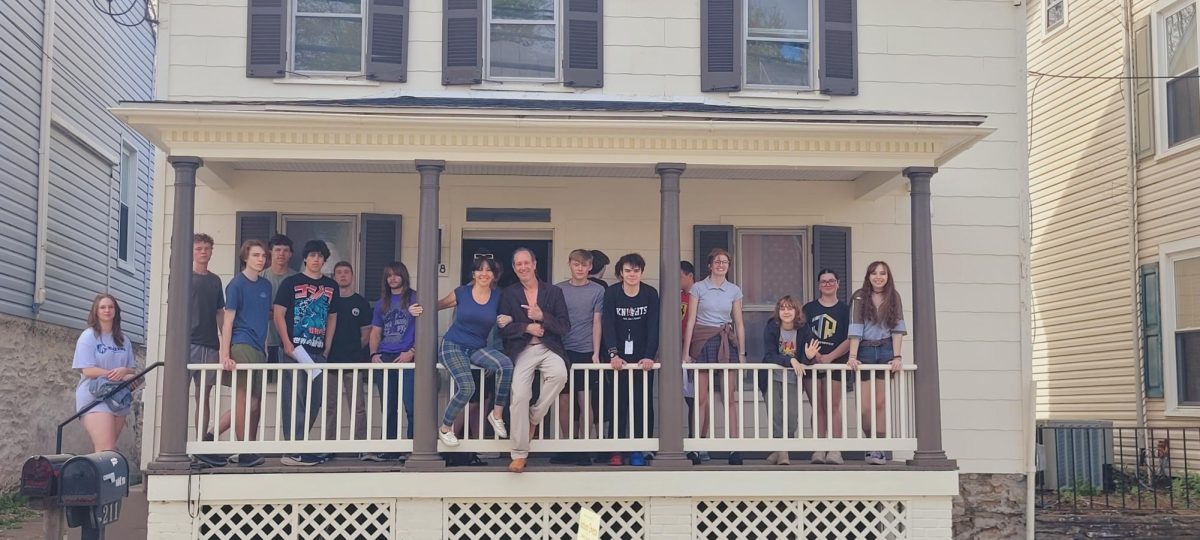
During a visit to one of Ms. Camille Pellegrino Spinelli’s current renovation projects, students from Mr. Haardt’s Money, Finance, and Economics class had the chance to ask her questions about real estate, wholesaling, flipping, and the financial realities behind the business. Here are some of the questions the students had for Ms. Pellegrino Spinelli.
Q: How did you get started in the house‑flipping business?
A: “I actually started out of necessity. I’ve always been a problem solver — I had a tough upbringing, dropped out of school in 10th grade, and had to figure things out on my own. Over time, I realized I had a natural ability for entrepreneurship and solving complicated issues. That skill set pushed me into real estate, and eventually into flipping.”
Q: How much did you end up paying for this house?
A: “When investors were going back and forth naming prices, I didn’t plan to go high. I offered $150,000, and almost by luck, I ended up getting it for that amount.”
Q: What is a common misconception people have about house flipping?
A: “People think you make millions. My mom even told her friend that. But no — that’s not the case. There’s a lot of risk and emotional regulation involved. I only made $1,800 on my last flip, and anything can happen: the market can tank, interest rates can spike, a war can break out, buyers can disappear. You can end up underwater and forced to sell at a loss. It’s not guaranteed money.”
Q: What are things you have to manage carefully to keep your profit from shrinking?
A: “Delays, cost overruns, and pricing mistakes — even small ones — can completely destroy your profit. You have to be disciplined.”
Q: What should people know before getting into house flipping?
A: “Real estate profit isn’t just buying and selling. It includes repairs, renovations, holding time, financing costs, selling fees, and strategy. You can’t just name a price and throw it on the market. You need a real market strategy.”
Q: What’s your definition of ‘market strategy’?
A: “Market strategy is understanding the numbers: what you can offer, what the rehab will cost, what the holding costs will be, and what the final sale price realistically is. For example, this property was originally listed by a wholesaler for $197,000. After running my numbers — including a $105,000 rehab budget and all holding costs — the deal only made sense at $150,000. I told the wholesaler the numbers didn’t work, and I was willing to walk away. A week later he came back and offered it at $157,000, which I could make work. That’s market strategy.”
Q: What were the conditions of this house when you bought it?
A: “It was completely gutted. No ceiling, no drywall, barely any electric, no AC, and the family living here had a baby and a mother with a brain tumor. They were using space heaters in November. The kitchen was from the 1970s and falling apart. There were structural issues — the main beam holding the house had been cut in half. Most people would’ve run, but my contractor brought in a structural engineer and we handled it.”
Q: What is an escalation clause, and how does it work?
A: “If you’re buying a home and don’t want to lose it over a small amount, you can add an escalation clause. It says you’ll go a certain amount — say $1,000 — over the highest competing offer, up to a limit. The agent must prove the competing offer is real. It increases your chances of winning the deal.”
Q: Why would someone ever pay more than the house is worth?
A: “Sometimes you know something others don’t — maybe a major hotel is being built nearby, or the area is about to boom. You might lose money monthly but gain huge appreciation later. It’s risky, but some investors do it. For this property, though, that didn’t make sense.”
Q: What design choices did you make in this renovation?
A: “People buy homes for kitchens and bathrooms. I added vintage touches to match the home’s history — it’s one of the oldest cabins in Middletown, from the 1800s. I staged the living room because it’s small and buyers need to visualize the space. I added wallpaper, recessed lighting, a redesigned master suite, a functional kitchen island, hidden appliance storage, and updated HVAC throughout.”
Q: What challenges did you run into during the renovation?
A: “A few. The water heater thermostat malfunctioned and caused a massive electric bill. The roof was more expensive than expected. The inspector wouldn’t allow a double sink upstairs because of spacing rules, so I had to redesign the bathroom. And because of the unexpected costs, I couldn’t afford the full fence I wanted, so I built a smaller, safer version myself for about $500.”
Q: What is the After‑Repair Value (ARV) and your expected sale price?
A: “Zillow estimates the ARV at around $429,000, though Zillow is usually low. We’re listing at $387,000. My lowest acceptable price is $350,000 — that still leaves me with around a $23,000–$24,000 profit.”
Q: What was your total repair cost?
A: “About $326,000 to turn this $150,000 house into something worth nearly $400,000.”
Q: When did you buy this house?
A: “I started working on it a little under six months ago.”
Q: What would you say is the hardest part of house flipping?
A: “Emotions. If you can manage your emotions — not overspend, not panic when contractors mess up, not lose control — you’ll survive. Emotional discipline is everything.”
Q: What type of buyer do you expect for this house?
A: “Probably someone who wants to live downtown. Street parking and the unfinished basement make it less ideal for some, but it could also be a great Airbnb. Still, I expect a long‑term homeowner.”
Q: What’s the biggest mistake you’ve made in your flipping career?
A: “Honestly, I don’t see mistakes as failures. I see them as information. Positive thinking is what makes a good salesperson. For example, we once had $200,000 stolen from us in a Ponzi‑scheme‑like investment. Instead of letting it destroy me, I used it to rebuild smarter. Resilience is everything.”
Q: What rule do you use to make sure a deal is safe?
A: “The 70% rule. Take the ARV — say $375,000 — multiply by 0.7, and all your costs (purchase, rehab, holding) must fit under that number. That gives you a cushion for surprises, and there are always surprises.”




Jackson "JC" Chubin • May 28, 2026 at 2:40 pm
Yes that would be 208 west main street Middletown Maryland 21769- JC
Anonymous • May 20, 2026 at 7:41 am
Can you share the address of this house?